
Ulrich of Hohensax (1460? – 1538)
On 19 April 1512, the Swiss Tagsatzung, the legislative and executive council of the Swiss Confederacy, appointed Ulrich of Hohensax supreme commander of the confederate army, which was preparing to enter Lombardy. The Council of War confirmed the Tagsatzung order on 30 May, making Ulrich of Hohensax the first commander-in-chief in Swiss history. The campaign ended on 31 December, when Ulrich of Hohensax led the Swiss army into Milano and restored Massimiliano Sforza to the throne. With the success of this operation, the Confederates strengthened their position, becoming equal partners with other European powers.
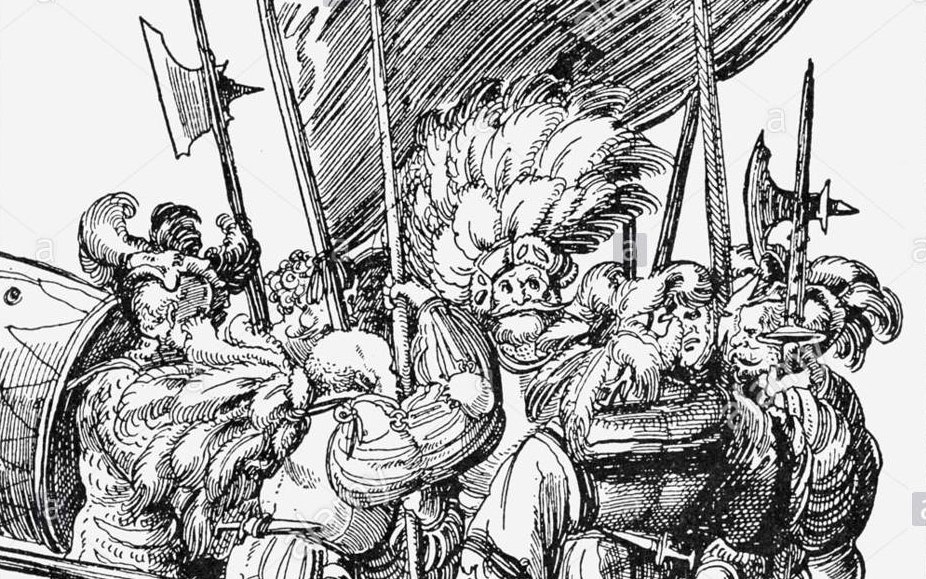
Ulrich of Hohensax was born around 1460 (the exact date is unknown) at Forstegg Castle in Sennwald, in the Canton of Saint Gallen. Little is known about his early childhood. In his youth, he served as a squire to Emperor Friedrich III. In 1475, when he was placed under the guardianship of Hans Waldmann, he began his military career. He took part in the siege of Neuss, fought in Grandson in 1476, and at the battle of Murten he commanded a contingent of 2,000 men from Eastern Switzerland. Because of his bravery, he was knighted on the battlefield by René II, the Duke of Lorraine, and the Count of Thierstein.
In 1486 he became a citizen of Zurich and returned to foreign services as captain of a Zurich company in the pay of Siegmund of Austria. He showed great courage in the Trentino campaign. In the Milan wars the Tagsatzung, confirmed by the Council of War, gave him supreme command of the Swiss troops, which for the first time were united under a single commander. At the end of the campaign, he returned to Switzerland but left a Swiss garrison in the main cities of the Duchy of Milan, which were now under the protection of the Swiss. He was once again to be found at the head of the federal troops that defeated the French again in Novara in 1513. Two years later, however, he was forced to remain in Switzerland for health reasons and was therefore unable to command the troops in the Battle of Marignano, the "Battle of the Giants", in which the Swiss Confederates were defeated.
From 1516, Ulrich of Hohensax became a French commissioner as one of the contracting partners of what is known as the "Eternal Peace". With the beginning of the Reformation, Ulrich von Hohensax withdrew to his estates. In 1531 after the Second War at Kappel, he was once again appointed mediator in the peace treaty between the Confederates.