
Niklaus Rudolf von Wattenwyl (1760 – 1832)
Niklaus Rudolf von Wattenwyl was born on 3 January 1760 in Bern. His family was one of Bern's largest patrician families and represented in the city's government. Niklaus Rudolf von Wattenwyl was an officer in the foreign service, a member of the provisional government and of the Consulta in Paris, president of the Cantonal Council of Bern, Landammann (chief political officer) of Switzerland and President of the Federal Diet that appointed him Supreme Commander of the Army in 1805, 1809 and 1816.
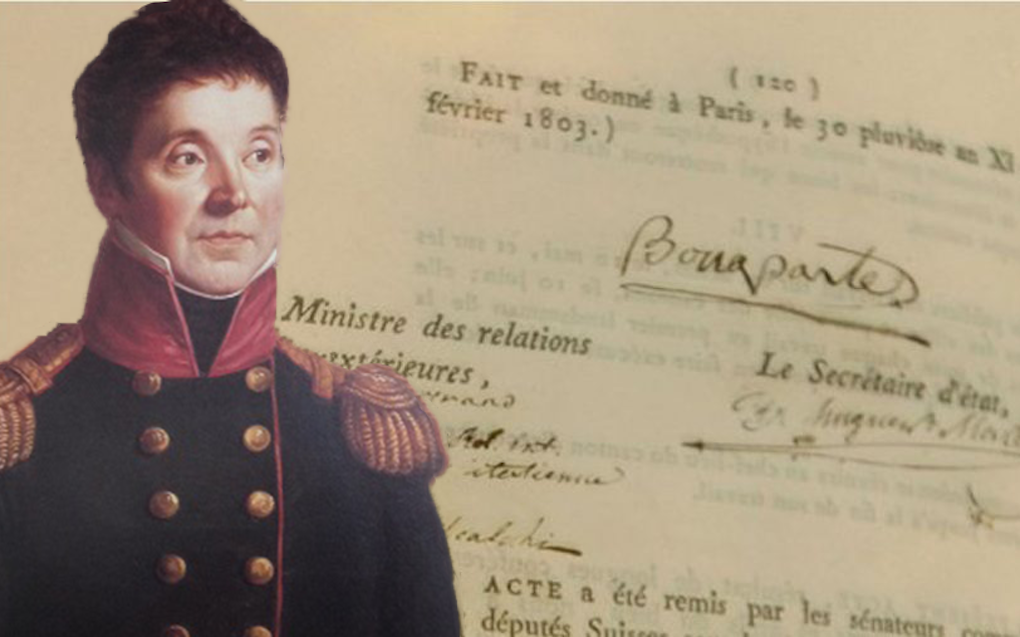
Niklaus Rudolf von Wattenwyl was educated by private tutors and at an institute in Strasbourg. At the beginning of his military career from 1776 to 1784, he was officer of the Bern Stürler Regiment in the service of the Netherlands, where he was promoted to grenadier captain. When he returned to Switzerland in 1795, he began his political career as a member of the Bern city parliament. He was also a militia commander in the Thun cantonal regiment and, with his troops, stopped the advance of the French army at Neuenegg in 1798. During the Stöckli War in 1802, he commanded a battalion in the Berner Oberland. In 1803 he was sent as a deputy from Bern to the Paris Consulta, and became a member of the Bern Scholastic Council; in 1804 he was appointed Landammann of Switzerland (a position he would hold again in 1810). The general military regulations for the Swiss Confederation, which he drew up with the aim of reorganising the Swiss army after the dissolution of the Helvetic Republic, were adopted by the Diet on 22 June 1804.
When the war broke out between France and the Third Coalition in 1805, Switzerland, situated between the two adversaries, had to defend its neutrality. On 21 September, after von Wattenwyl had joined the federal staff that he had helped to create, the Diet mobilised four divisions and appointed him general. Following Napoleon's victory at Austerlitz on 2 December, the Swiss army was disbanded (on 10 December 1805). No violation of Swiss territory had occurred in that war but in March 1809 hostilities between Austria and France began with an incursion over the Swiss border. In April, the Diet ordered the mobilisation of a third of the cantonal contingents under the command of General von Wattenwyl, and placed another third on standby. With the signing of the Schönbrunn Treaty on 14 October 1809, the federal army was demobilised in late autumn. On 19 October 1813, following Napoleon's defeat in Leipzig, the fighting came closer to Switzerland again and, on 18 November the Diet ordered the third mobilisation under Niklaus Rudolf von Wattenwyl's command. On 19 December 1813, the Prince of Schwarzenberg, commander of the troops of the Sixth Coalition, informed von Wattenwyl of his intention to enter Switzerland with the Austrian army. On 21 December, despite the general's opposition, the Austrians entered Switzerland without the Swiss army being able to oppose them due to their inadequate, undisciplined and uneducated staff and a lack of equipment.
Von Wattenwyl was held in high regard within the Federal Diet and served as its president after the Restoration in 1817, 1823 and 1829. As the head of the reformist party (from 1827), he worked closely with the liberals in 1830, offering them freedom of trade, tax breaks and the abolition of censorship. Niklaus Rudolf von Wattenwyl can to be credited with allowing the transformation of the patrician regime in Bern into a democratic state without bloodshed. He died on 10 August 1832 in Aarburg.