
Guillaume Henri Dufour (1787 – 1875)
On 4 November 1847, General Dufour, commander-in-chief of the Swiss army, fully aware of Switzerland's difficult situation, (the day after the cantons of the Sonderbund had attacked the Canton of Ticino and triggered hostilities) urged his division commanders to curb their feelings of hatred towards the Sonderbund cantons in order to avoid compromising the future cohesion of the Confederation. The Confederation's last civil war ended 25 days later, leaving less than 100 casualties on the battlefield and laying the foundations for a new constitution.
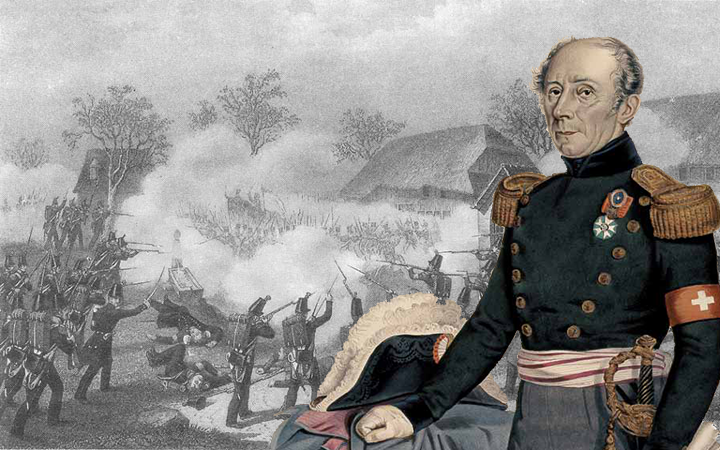
Guillaume Henri Dufour was born in Constance on 15 September 1787. His family moved to Geneva, where, after leaving school, he studied humanities and physics. Later he continued his studies at the Ecole polytechnique in Paris and the Ecole supérieure d'application du génie in Metz. From 1811, he served as an officer in the French military engineer corps. In 1817 he left the French army and returned to Geneva where he worked as a cantonal engineer until 1850. From 1845 to 1856 he was also responsible for creating the cantonal land register map. He joined the newly established Swiss army as a captain in 1817. Three years later he was promoted to lieutenant colonel and in 1827 to colonel. In 1819 he co-founded the Federal Military School in Thun, where he was an instructor for the engineer corps until 1831. In 1832 he was appointed the army's Chief of General Staff.
On 21 October 1847 the Swiss Diet appointed him commander-in-chief of the Swiss army with the rank of general for the first time and tasked him with dissolving the Sonderbund. In August 1849, during the revolution in the Grand Duchy of Baden, the Federal Assembly again appointed him commander-in-chief of their forces in order to prevent possible attacks on Swiss territory. On 27 December 1856, in their attempt to defend Neuchâtel from the Prussian army, the Federal Assembly made him head of its troops for the third time. Dufour was appointed general for the fourth time in 1859, when the army was mobilised following a conflict in Lombardy in which the French and the Piedmontese were fighting against the Austrians.
Besides his activities as an engineer and an officer, Guillaume Henri Dufour enjoyed a successful political career. In 1819, he was elected to the Council of Representatives in Geneva, where he represented the Liberals. After the Geneva Revolution in November 1841 he was elected to the Cantonal Constitutional Council, and in 1842, to the Cantonal Council and the Communal Council. At national level, he represented the Seeland region in the National Council from 1848 to 1851, and Geneva from 1854 to 1857. From 1862 to 1866 he represented Geneva in the Council of States. In 1867 he retired from public office, and he died in Geneva on 14 July 1875 at the age of 87.
A successfull civilian life
Guillaume Henri Dufour is remembered for many achievements and not simply for his military career. From 1832 onwards, he was in charge of the triangulation work that led to the 1:100 000 scale national map, which was completed in 1864, and has been named after him. In 1863 he was one of the five co-founders of the International Committee for Relief to the Wounded that later became the International Committee of the Red Cross, of which he was the president during its first year. Also in 1863, the highest peak in Switzerland in the Monte Rosa massif (4634 m), was dedicated to him and named the Dufourspitze. On 25 February 1863 Napoleon III appointed Guillaume Henri Dufour a Grand Officer of the Legion (in which he already had been made a knight on 22 January 1813, an officer on 11 January 1832 and a commander on 16 March 1849).